
For much of the past year, the conversation around artificial intelligence in commercial real estate has centered on speculation — particularly whether AI would reduce the need for analysts and other early-career roles.
But the reality emerging across the industry looks different.
Recent polling conducted by RETS Associates suggests AI adoption in CRE is moving less toward job displacement and more toward workflow and talent transformation.
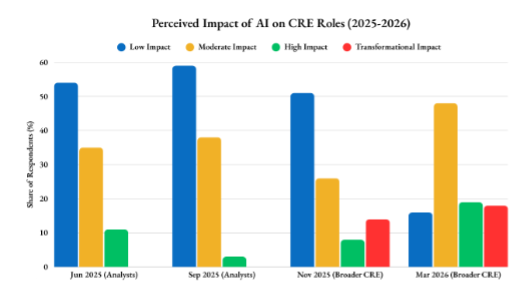
When RETS first surveyed CRE analysts in mid-2025, the impact was limited, with a majority of respondents reporting AI was having minimal influence on their roles, and most applications confined to basic data processing or early automation of repetitive tasks. Even as late as September, nearly 60% of analysts still reported minimal impact, reinforcing the perception that AI was more curiosity than catalyst.
But when RETS expanded polling to the broader commercial real estate community in November, sentiment had shifted, rapidly. By late 2025, CRE professionals increasingly reported AI affecting how they worked. And by March 2026, nearly 40% of CRE professionals said AI was meaningfully impacting or actively transforming their daily workflows, while only 15% reported little to no impact.
What changed? Not necessarily the technology — but how professionals began using it.
Across the industry, AI is quietly becoming a productivity layer: summarizing research, assisting with analysis, organizing market information, and streamlining communications. These tools are not replacing expertise, but they are reducing the time spent on time consuming tasks.
For early-career professionals, that shift may actually raise the bar rather than eliminate roles. As routine work becomes automated, the industry is likely to place greater value on interpretation, judgement, and strategic thinking.
For employers, the shift may ultimately influence how teams are built. As AI reduces time spent on manual analysis and administrative tasks, firms are increasingly prioritizing professionals who can interpret information, communicate insights, and make strategic decisions.
The real question for CRE professionals is no longer whether AI will impact the industry — but how quickly those who adopt it gain an advantage over those who do not.
